Archives for 2006

My definition of “software design archeology” and “software anthropology”

I recently used the term software design archeology and realized that it’s not a widely used term from what I can tell, so I felt it might be a good idea to clearly present a definition for it. A complementary term, software anthropology should probably get a definition, as the two are related. I welcome any criticism or feedback about my use and definition of these terms, so we can all share a common vocabulary around the activities they represent.

My working definition starts by taking the existing definitions for archaeology and anthropology and replacing the references to humans with the phrase “software design” along with other relevant changes. I’m not sure if this constitutes plagiarism, but it is certainly not what is intended. The definitions I’m starting with are certainly not my own and my new use of them is simply derivative work for the benefit of the scientific community to broaden our shared vocabulary.

archeology[1], n.: The systematic study of past human life and culture by the recovery and examination of remaining material evidence, such as graves, buildings, tools, and pottery.

software design archeology, n.: The systematic study of past software’s design by the recovery and examination of remaining material evidence, such as design notes, chat logs and transcripts, mailing list archives and interviews.

anthropology[2], n.: The scientific study of the origin, the behavior, and the physical, social, and cultural development of humans.

software anthropology, n.: The scientific study of the origin, the behavior, and the physical, social, and cultural development of software.

[1] “archaeology.” The American Heritage® Dictionary of the English Language, Fourth Edition.
Houghton Mifflin Company, 2004. Answers.com 08 Aug. 2006.
http://www.answers.com/topic/archaeology

[2] “anthropology.” The American Heritage® Dictionary of the English Language, Fourth Edition.
Houghton Mifflin Company, 2004. Answers.com 08 Aug. 2006.
http://www.answers.com/topic/anthropology

Is the time ready for such a study to be undertaken by academics? Is there sufficient interest? Would a university recognize this as a worthwhile endeavour? I’ve been thinking lately about pursuing a Masters or Ph. D. degree, perhaps this could be something I could pursue. Any suggestions where to start?

As always, I welcome everyone to leave a comment below. Thanks!

Tags:
,
,
,

On iterative, open source documentation (or lack thereof)

AOL has put together developer.aol.com to highlight its contributions to the web community, but one of AOL’s earliest contributions, AOLserver, is silent from the list. (Yes, I did mention this to someone internally at the end of May 2006, and projects that have launched since have made it to the list, already.)

Jeremy Zawodny expresses what I’ve been trying to put into words for a while now about the difficulty of contributing previously closed source, which AOLserver was prior to 1999. The AOLserver community has always been anxious to see more of AOL’s closed source components for AOLserver get released as open source, most famously the “DCI” collection of modules which was invented as part of the AOL Digital City (now AOL CityGuide). So, what’s kept AOL from “being a better open source citizen” (if that’s really what it would mean) and releasing the DCI modules?

Jump-starting an open source community like AOLserver with a sizable and previously closed source codebase presents an interesting challenge. Most likely, the design discussions were held in face-to-face meetings, some now outdated design documents may have been created and the software was constructed under commercial pressures with all the sacrifices and trade-offs that come with them. Much of the knowledge and design rationale is primarily locked up in two artefacts: the initial developers’ brains and the produced code itself. Releasing any portion of the code alone significantly raises the bar of required understanding for participation and contribution. Making those brains available in the form of community participation (i.e., answering questions) means dedicating some non-zero percent of your most valuable asset: your people.

Contrast this with an open source community that starts from scratch, with nothing at the start. All design discussions are generally held using communication methods that are easily archivable and searchable. Even if no explicit design document artefacts are produced before software construction, a determined software design archeologist could pore over the chat logs and transcripts and mailing list archives to reconstruct the key points that drove the design using resources that are already publically available. After the documentation is started this way, the community can continue to refine and contribute to it through distributed collaboration tools, which is why I’m a big fan of Wiki software.

Is this documentation really that necessary? Again, for some people, probably not: the bar of required understanding is low enough for them. But, that set of people is quite small. There are folks at AOL who have full access to all our source code who still can’t make heads or tails of our stuff, who need serious hand-holding to make things just work. Imagine the difficulty a member of the community would have, not having access to all the code and all the people who know it well. For many, making more of our closed source code open would be next to useless to them. So, where’s the rush to open it up until all the necessary prerequisites (documentation, examples, etc.) are available?

So, given the situation, does this make AOL (or Yahoo!, or Google) poor open source citizens because it hasn’t put a license on more of its code and made it available to the community? Does it necessarily imply that the quality of the code is poor because it’s not easily open sourced? Is there a lesson about gift horse mouth inspection going on, here? I can’t speak for Yahoo! or Google, but take my word for it that the members of the AOLserver community who work at AOL have been continuing to clean up and better document more of the still-closed source AOLserver modules (like the DCI modules) with intent to eventually release them.

Tags:
,
,
,
,
,

I saw the Witch Doctor and she told me what to do …

So, back in April I separated from my family because I just couldn’t live with them any more. After a month and several phone calls back and forth, my wife and I agreed to give things another chance and I came back home. Divorce didn’t really seem like a workable solution. The time apart helped me see that I really cared way too much about things that really didn’t matter. As apathetic as I thought I was before, I’m far more apathetic now and my life’s actually improved as a result.

After returning, I decided to find a new therapist. The one I’d been seeing for the last few years just wasn’t getting me anywhere. So, after a bit of procrastination, I’d made appointments to see a new psychiatrist and new psychologist. I wasn’t looking forward to starting all over again, but then, what did I have to lose? Towards the end of July, I met my new psychiatrist, Dr. P., and my new psychologist, Dr. H.

I’ve never tried antidepressants. Not because I thought I didn’t need them, but because I think selection is too random since we lack of sufficient understanding of the brain. Of course, the psychiatrist suggested I try out Paxil CR and started me on a 15mg dose for four weeks. Since my last visit, she’s recommended upping the dosage to 25mg and we’ll see how that goes. I’ll be finishing up the 15mg pills later this week and will start the 25mg right after.

If I was apprehensive about starting new drugs, I’m even more so about starting with a new psychotherapist. I’m not sure I believe that problems can be fixed by talking. In our first session, I speed-rambled through about 7 years of highlights between 1999 and 2006 as best I could in 45 minutes. I’m sure I missed a lot of important details, but I wanted to give Dr. H. an idea of where I’d been emotionally the last several years. During the conversation, I’d mentioned that I have what I’ll summarize as identity and acceptance issues: I’m perfectly comfortable with myself–who I am–and accept myself. This works fine for me in isolation, but unfortunately there’s a whole world of people out there that I have to interact with, most importantly my wife and children. My wife has her own list of my personality flaws which she’d like to see changed, but I’m extremely apprehensive about making them arbitrarily: I’d much rather be the way I am than change the “wrong” thing about myself and end up hating myself. So, Dr. H. suggested that I start keeping a journal (perhaps, like this blog?) as a means for introspection. This way, I can start looking at my life more objectively and come up with my own list of things I dislike about myself and then we can work on making changes through therapy. I definitely like this suggestion, but I need to overcome my inability to put my thoughts into writing which is a huge problem for me.

Consider this blog entry the first step in my self-improvement.

Tags: , , , , , , ,

Dr. Demento 20th Anniversary Collection (2-CD set)
If you were looking for the David Seville “Witch Doctor” song, I suggest you check out the Dr. Demento 20th Anniversary Collection. It is a 2-CD set and the “Witch Doctor” song is on the first CD, track15.

del.icio.us/dossy links since July 31, 2006 at 09:00 AM

del.icio.us/dossy (RSS) links since July 31, 2006 at 09:00 AM:

del.icio.us/dossy links since July 24, 2006 at 09:00 AM

del.icio.us/dossy (RSS) links since July 24, 2006 at 09:00 AM:

I know a guy, who knows a girl, who knows Mel Gibson!

Apparently, Mel Gibson was busted for a DUI arrest. If driving under the influence wasn’t bad enough, he was apparently throwing out anti-Semitic remarks in the process. He’s since apologized for his behavior, but that’s not what really worries me. What worries me is this:

Mel Gibson (credit: http://bear-blog.blogspirit.com/images/medium_mel-gibson.4.jpg)
Osama Bin Laden (credit: http://www.nndb.com/people/669/000023600/osama-med.jpg)

Is Mel too deeply involved in some method acting for a new role where he plays an anti-Semitic Muslim terrorist, or was he just losing his mind?

Also, to give credit where it’s due, the title of this blog entry is a take-off of an Adam Sandler song (which, sadly, I can’t find a reference to–Google, you have failed me!) … who, by the way, is a Jew. Okay, that was a complete non sequitur.

(via [info]substitute)

Tags:
,
,

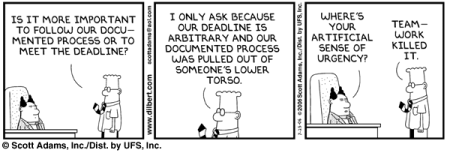
Dilbert: Where’s your artificial sense of urgency?

Dilbert, 2006-07-25

Dilbert, to PHB: Is it more important to follow our documented process or to meet the deadline?
Dilbert: I only ask because our deadline is arbitrary and our documented process was pulled out of someone’s lower torso.
PHB: Where’s your artificial sense of urgency?
Dilbert: Teamwork killed it.

Some days, I swear, Scott Adams must be following me around, watching me work.

Tags:
,
,
,

Our nine senses? Exactly what is a sense, anyway?

Mark Poesch asks on his blog, “Why is it that all children are taught that they have only “five senses”…. Doesn’t a sense of gravity (i.e., acceleration) count as a sixth? …could you live without it?” I responded in the comments that I tend to think that it falls under the sense of “touch” as there’s a physical mechanism in the inner ear–specifically, the macula utriculi and macula sacculi[1]–that is responsible for our sense of gravity or linear acceleration.

No surprise, the Wikipedia entry for “sense” points out that the definition of “sense” isn’t well defined. Given a certain definition of sense, there are nine human senses: vision (sight), audition (hearing), gustation (taste), olfaction (smell), tactition (touch), thermoception (heat, cold), nociception (pain), equilibrioception (balance, gravity), proprioception (body awareness). So, it seems Mark is right, conventional wisdom considers gravity its own separate, dedicated sense.

However, in the comments to his blog entry, I asked: “What about “sense of time”? Is that simply cognition (and not a sense)? Probably.” Of course, Wikipedia has an entry on “sense of time” too, which says: “Although the sense of time is not associated with a specific sensory system, the work of psychologists and neuroscientists indicates that our brains do have a system governing the perception of time.” Why isn’t it associated to a specific sensory system? Is the prerequisite for a sense that it must have a corresponding sense organ? This can’t be, since thermoception, nociception and proprioception fail to meet this criteria. If senses are the perception of stimuli, the passing of time definitely causes a stimulus which we perceive.

It appears that back in 2001, researchers identified that the basal ganglia and the parietal lobe are responsible for perceiving the passage of time. Perhaps this provides for a solid explanation for deja vu and other temporal sensation anomalies?

What do you think? Share your thoughts in the comments below.

Tags:
,
,
,
,

del.icio.us/dossy links since July 17, 2006 at 09:00 AM

del.icio.us/dossy (RSS) links since July 17, 2006 at 09:00 AM:

So, what’s wrong with the new AOL CityGuide Beta?

AOL CityGuide Beta logo

The beta of AOL CityGuide was announced today (see the list of cities in beta). Since my current project–you know, the one that makes me want to find a new job–is tangentially involved with CityGuide, I have some interest in the product.

As Jason Calacanis says, “the first step in sucking less is knowing that you suck.” Unfortunately, society has been so severely perverted by political correctness that folks can’t tolerate anything but constructive criticism. Frankly, that’s a big wad of bull-hooey. Sometimes, your best feedback comes from those who are the most passionate and that can sometimes lead to angry flailing. You can trust me that I’m smart enough to read what you write, listen to what you mean and appreciate the time you took to share it. It’s more important to me that you tell me the truth than the way in which you express it. So, in that spirit, I put forth a few questions:

  • What do you hate about the new AOL CityGuide beta?
  • What features are missing? Looking for something you can’t find?
  • What is wrong with it? Anything broken or stupid?
  • What would it take to make you want to use the product?

Of course, I’d love to hear your positive feedback, too! Tell me what you love about the product, what you find most useful, how you couldn’t live without it, and so on. I’m sure the folks working hard on the product would appreciate hearing it, now and then. But, I think if we listen to and act on the negative feedback, it will lead to more people eventually giving positive feedback, so tell me what’s on your mind.

Oh, and just in case you’d never seen the AOL CityGuide product, here’s a quick visual comparison, with links to both:

Before:

After:

Tags:
,
,